|
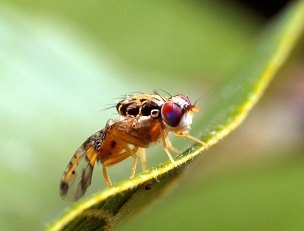
| C. capitata adult. Photo by Scott Bauer, USDA-ARS |
MED-FOES is an implementation of a stochastic Agent-Based Simulation (ABS) system for analysing demographic changes in a single population of Medfly (Ceratitis capitata) over time. The simulation currently takes population extinction as a given because it aims to give us better estimates of necessary quarantine lengths in areas where Medfly is not currently established but does repeatedly invade. Thus the objective of this software is to estimate the time to local extirpation based on known ranges of developmental, survivorship and reproductive parameters, as well as assumed ranges of an eradication pressure parameter. For a complete analysis and estimate of time to extirpation one would execute a large number of individual simulations evenly distributed over parameter space to estimate the time at which an arbitrary percentage of the simulations show extirpation.
MED-FOES differs significantly from the most common current approach to estimating the time to extirpation of invasive insects generally, the Thermal Unit Accumulation approach, also called the “degree day” method. It is important to note that MED-FOES substantially differs from it in at least three important ways. 1) It is demographically explicit, 2) it includes the possibility of rare events, 3) it includes consideration of natural and human-induced mortality.
As of version 0.6 MED-FOES includes spatial modeling of trapping during an eradication campaign via TrapGrid.
Download page: Click here
The download is an installer which includes a compiled version of the ABS, associated programs, documentation, samples and source code. Further project details, including older versions, some screenshots and more can be had by following this link.
Videos for helping you install and run MED-FOES are available on YouTube. Please click here to view them.
Comments and requests for help can be directed to the author of the software, Nicholas Manoukis. The best way to reach him is by email: nicholas.manoukis [at] ars.usda.gov (replace [at] with @).
Nicholas C. Manoukis and Kevin Hoffman.
An agent-based simulation of extirpation of Ceratitis capitata
applied to invasions in California.
Journal of Pest Science, 87(1):39-51, 2014.
[DOI |
http ]
Nicholas C. Manoukis, Brian Hall, and Scott M. Geib.
A computer model of insect traps in a landscape.
Scientific Reports, 4:7015, 2014.
[DOI ]
This software was written by Nicholas C. Manoukis. The original idea for the project came from a workshop in Raleigh, NC at CPHST in March 2011. A paper describing the general approach and applying it to Medfly outbreaks in California was authored by Manoukis with Kevin Hoffman of CDFA (see Publications, above).
Hosting provided by: